

Gregory Tutt
Chief Technology Officer, Strato
As AI accelerates execution across engineering and operations, one of the next leadership challenges may be managing the human attention, prioritisation, and operating discipline required to keep pace.
Over the past year, one of the most interesting changes inside our engineering organisation has not simply been the adoption of AI.
It has been the way AI is changing the rhythm of how we work.
Like many teams, we first introduced AI as a supporting capability. It helped review work, generate drafts, validate ideas, assist with documentation, and speed up certain technical tasks. Humans were still doing most of the execution, while AI supported activity around the edges.
What I am seeing now feels different.
AI is increasingly handling more of the operational leg work. People are spending more time reviewing, orchestrating, validating, prioritising, and making judgement calls across multiple streams of work at once.
The nature of the work itself is changing.
AI Is Changing the Rhythm of Delivery

One of the biggest shifts for us has been using AI within tighter cross-functional delivery pods.
Instead of work moving sequentially between business analysts, developers, testers, architects, and documentation teams, people are working from a more shared context from the beginning. The work becomes less about passing tasks from one group to another, and more about moving together around the same outcome.
That changes the rhythm of delivery.
When teams are aligned around the same context, and AI is accelerating activity across each role, some traditional bottlenecks start to reduce. There are fewer handoffs, shorter waits for information, faster iteration cycles, and less friction between stages of delivery.
Ideas that previously took weeks to move from concept to implementation can now become tangible in much shorter cycles.
We are seeing similar patterns outside engineering as well. In support operations, for example, we have been building AI agents that analyse incoming tickets before they reach customer care teams. The goal is not to remove people from the process. It is to reduce repetitive operational work and give support teams better context earlier in the interaction.
Operationally, this creates enormous opportunity. But it also introduces a different kind of pressure.
The Productivity Gain Is Real, But So Is the Load

The productivity gains from AI are real. Work can move faster. Teams can explore more ideas. Tasks that previously took hours can sometimes be completed in minutes. Problems that were once too expensive or time-consuming to investigate can become active streams of work much sooner.
That is a meaningful change.
But I have also started noticing something I do not think organisations are discussing enough yet: cognitive load.
Historically, delivery cycles had built-in pacing. Work moved through phases. There were pauses between thinking, execution, validation, and rollout. Those pauses were not always efficient, and they were often frustrating from a delivery perspective, but they gave teams time to reset, reprioritise, and focus on one problem at a time.
AI changes that rhythm.
When execution becomes faster, organisations can progress more initiatives simultaneously. New ideas do not sit in backlogs as long. Prototypes appear quickly. Experiments happen continuously. More work can be opened, explored, reviewed, and moved forward at the same time.
That is powerful, but it also means people are switching context more often.
I do not see this as a negative consequence of AI. In many ways, it is a reflection of how useful these tools are becoming inside operational environments. The challenge is that human cognitive capacity has not increased at the same pace as execution capability.
AI can help teams move faster, but people still need to absorb the work, understand the context, make decisions, and decide what matters most.
The Bottleneck Is Moving

For a long time, the constraint in many technology environments was execution.
Could the team build fast enough? Could documentation keep up? Could testing be completed in time? Could support teams process the volume of work coming through?
AI changes some of those constraints.
It can help generate, analyse, summarise, test, document, and triage at a speed that changes what teams can realistically take on. But that does not mean the organisation becomes unconstrained.
In many cases, the bottleneck is no longer execution itself. It is attention.
People still need to review the output. They still need to understand the context. They still need to make trade-offs, assess risk, prioritise competing work, and make judgement calls. The work may move faster, but judgement still sits with people.
That is where I think the conversation about AI needs to mature.
It is not only about how much more work can be produced. It is also about whether the organisation has the structure to manage the additional pace, volume, and complexity that AI makes possible.
Structure Becomes More Important, Not Less
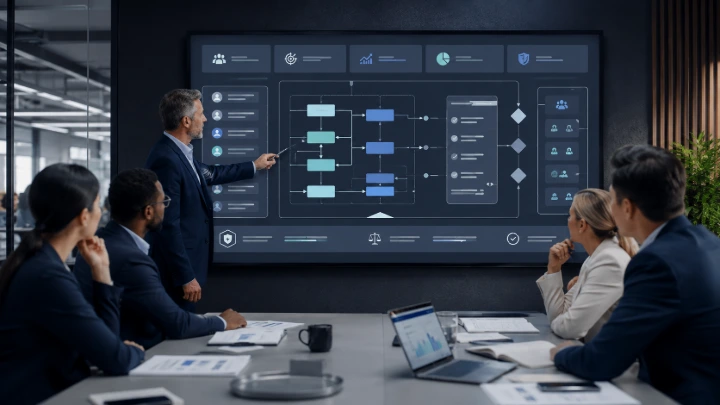
As organisations accelerate, structure becomes more important, not less.
Shared context, clear ownership, disciplined prioritisation, organised information, and well-defined workflows become critical because teams can now move faster than their operating models were originally designed to support.
Without that structure, AI can create a new kind of pressure. More ideas are active. More work is in motion. More decisions need to be made. More context needs to be held at the same time.
The risk is not that people become less productive.
The risk is that people become overloaded by the volume of work that productivity makes possible.
That is why leadership matters so much in this next phase of AI adoption. Teams need the tools to move faster, but they also need clarity about what should move, what should wait, who owns the decision, and how work connects to broader priorities.
Speed helps, but only if the organisation is clear about where that speed should be applied.
This Will Matter Across Workflow-Heavy Environments
I expect this to become increasingly visible across technology, HR operations, and workflow-heavy environments over the next few years.
AI is making it possible to operate at a pace that was not realistic before. But sustainable execution still depends on how people absorb, process, and manage that acceleration.
That matters in environments where work is not just about completing a task, but coordinating people, data, documents, approvals, rules, exceptions, and decisions.
In those environments, speed alone is not enough.
The operating model still matters.
I suspect the organisations that benefit most from AI will not simply be the ones adopting the most tools. They may be the ones that are most deliberate about how work is structured, how priorities are managed, and how people are supported as the pace of execution increases.
I am genuinely optimistic about where this is heading. AI is already changing how software is delivered, how operational work is performed, and how organisations think about productivity.
At the same time, one of the biggest leadership challenges over the next few years will be building operating models that support both acceleration and human capacity.
Because while AI can remove many operational bottlenecks, it does not remove human cognitive limits.