
Why separating approval, review, signature, notification, and audit can lead to more effective HR document workflows

Sheryl Grant
Global Enablement Lead
When organisations implement HR document generation, the early discovery work usually focuses on the documents themselves.
HR teams and subject-matter experts generally understand their templates, clauses, and business rules. They may identify wording that needs review by Employee Relations or Legal, find clauses that could be consolidated, or uncover regional variations that need clearer ownership. These discussions are important, but they are also a reasonably expected part of the implementation.
The more complex decisions often emerge when attention turns to the document workflow, particularly where the underlying employee transaction already moves through several approval stages in the HR system.
A promotion, salary change, transfer, contract variation, or other employee event may already have been reviewed and approved by multiple stakeholders before the document is created. When the document workflow is then designed, those same roles are sometimes added again because they were involved in the original business process.
That may be appropriate, but it should not be assumed.
A stakeholder may need to approve the underlying decision, review the wording of the document, authorise its formal issue, affix a signature, receive notification, or be able to confirm later that the process occurred. These are different responsibilities, yet they are often translated into the same solution: another approval step.
When that happens, document workflows can become longer and slower without necessarily becoming better controlled.
Approval Is Not the Same as Awareness
One of the most useful questions during workflow design is also one of the simplest:
What decision does this person need to make?
Some stakeholders have genuine authority to accept or reject the underlying employee change. Others need to verify that the resulting document accurately reflects what has already been approved. Employee Relations or Legal may need to review unusual wording, while an authorised representative may need to approve the formal issue of the document.
Other stakeholders may simply need visibility. They may want to know that the document has been created, issued, signed, accepted, or completed. They may also need access to reporting or an audit history because they are accountable for the broader process.
Those needs matter, but they do not automatically require an approval task. In some cases, a notification, dashboard, report, or reliable audit trail may provide the necessary visibility without placing another person in the critical path.
The Document Workflow May Be Repeating Decisions Already Made

Document generation rarely occurs in isolation. It usually sits within a broader HR transaction that may already have passed through a structured approval process.
For example, a salary change may have been reviewed by the line manager, HR, Compensation, and Finance. A promotion may already have received the necessary business approvals, while a transfer may have passed through regional, operational, and payroll checks.
When the document is created, it may still require review. However, the purpose of that review needs to be clear.
Is the stakeholder being asked to reconsider the business decision? Are they checking that the document reflects the approved outcome? Are they reviewing wording that falls within their area of responsibility? Are they authorising the communication on behalf of the organisation, or do they simply need to know that it has been issued?
Without this distinction, two overlapping workflows can emerge: one governing the employee decision and another appearing to govern the same decision through the document.
The additional steps may feel like stronger governance, but they may simply be repeating controls that have already been applied.
More Approval Steps Do Not Automatically Create More Control
Longer workflows often feel safer because they appear to provide more oversight. In practice, every additional step also introduces another dependency.
The document must wait for another person to act. Reminders may be required, tasks may need to be reassigned during absences, and progress may stall because someone is uncertain about what they are being asked to approve.
Lengthy approval chains can also blur accountability. When several people approve the same document, they may not all understand their role in the same way. One person may believe they are approving the employee change, another may be checking the wording, and a third may treat the task as an acknowledgement.
The result can be a workflow that appears highly controlled while leaving the purpose of each decision unclear.
The objective should not be to remove approvals simply to make the process faster. It should be to make sure that every approval has a defined control purpose and that the participant has the authority and information required to perform it.
Separating the Responsibilities Within the Workflow
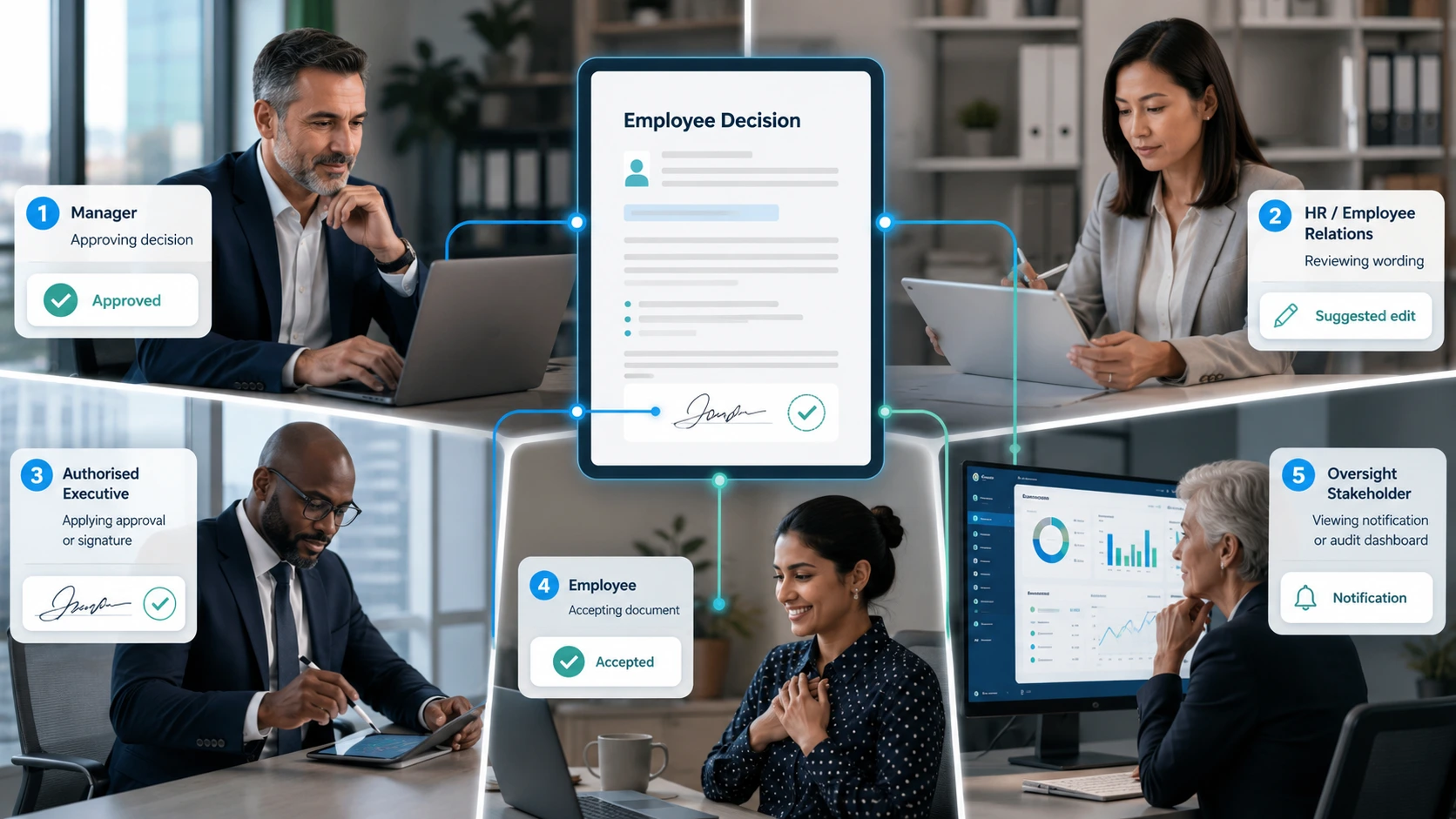
A clearer design begins by distinguishing the different responsibilities that may exist around an HR document.
Business decision approval
This is the approval of the underlying employee event, such as a promotion, salary change, transfer, employment offer, or contract variation. In most cases, this decision has already occurred within the HR system before the document is generated.
Document review
This confirms that the document reflects the approved outcome and contains the appropriate wording. HR, Employee Relations, Legal, Payroll, or another subject-matter expert may need to perform this review, particularly where the document contains an exception or non-standard content.
Formal authorisation or signature
Some documents need to be issued or signed by an authorised organisational representative. That person may be confirming that the document has passed through an approved process rather than reconsidering the underlying business decision, or verifying the document wording.
Employee action
The employee may need to accept, decline, acknowledge, or sign the document. This is a distinct part of the process with its own business meaning and should not be confused with internal review or approval.
Visibility and assurance
Other stakeholders may need to monitor the outcome or verify it later. Their requirement may be satisfied through notifications, reporting, status visibility, or audit evidence rather than an active workflow task.
Separating these responsibilities gives the organisation a more reliable basis for deciding who needs to sit in the approval chain and who can be supported in another way.
Ask What the Participant Can Legitimately Change

Another useful test is to ask:
What can this participant legitimately cause to change?
If the participant can reject the employee decision, require different wording, correct the document, withhold formal authorisation, or direct the process down another path, a review or approval step may be justified.
If the participant cannot change the outcome and is expected only to observe it, an approval task may not be the most appropriate mechanism.
This does not make the person’s requirement less important. It simply means that the control should match the need. Notifications can provide timely awareness, reporting can provide oversight, and audit histories can show who acted, what changed, and when the process was completed.
In some situations, these mechanisms provide better operational visibility than adding another approval that everyone treats as a formality.
Signature and Approval Should Be Considered Separately
Signatures can create additional ambiguity because the person whose signature appears on a document may historically have reviewed and signed every individual letter or contract.
In a digital process, the signature may serve a different purpose. It might indicate that the organisation has formally issued the document, that the signatory holds delegated authority, or that the document has passed through an approved process.
None of those automatically mean the signatory must manually review every document.
The appropriate approach will depend on the organisation’s policies, delegated authority model, legal requirements, document type, and level of risk. The important point is that signature and approval should be examined as separate requirements rather than treated as though they are always the same action.
Local Governance Expectations Need to Be Understood

Workflow requirements are shaped not only by process design, but also by organisational culture, local governance practices, and expectations around authority.
Across global implementations, it is common to see different approval and visibility requirements by country, region, or business unit. In some environments, senior leaders are expected to review or receive formal employee communications because their involvement reflects established authority, accountability, or respect for organisational hierarchy. In others, the same level of oversight may be provided through delegated authority, reporting, notification, or audit evidence.
Neither approach should automatically be treated as right or wrong.
A workflow that appears unnecessarily complex when viewed from one regional perspective may serve an important cultural or governance purpose in another. Removing a senior stakeholder from the process without understanding that context can create concern, reduce confidence in the solution, or overlook how accountability is understood locally.
At the same time, implementation provides an opportunity to clarify what each stakeholder genuinely requires. Does the senior leader need to review and approve every document? Do they need to authorise its issue, have their signature applied, receive a copy, be notified, or simply have confidence that the process can be audited?
These distinctions allow organisations to preserve appropriate local expectations while considering whether every requirement needs to become a blocking approval step.
For global organisations, one workflow design may not be suitable for every country or employee population. The objective should not be to impose uniformity where legitimate cultural or governance differences exist. It should be to understand those differences, document their purpose, and design an appropriate level of control for each context.
Cultural sensitivity is therefore an important part of workflow design. Standardisation still has value, but it should be applied thoughtfully, with room for justified local variation rather than assuming that one model will work everywhere.
Use Additional Review Where It Adds Value
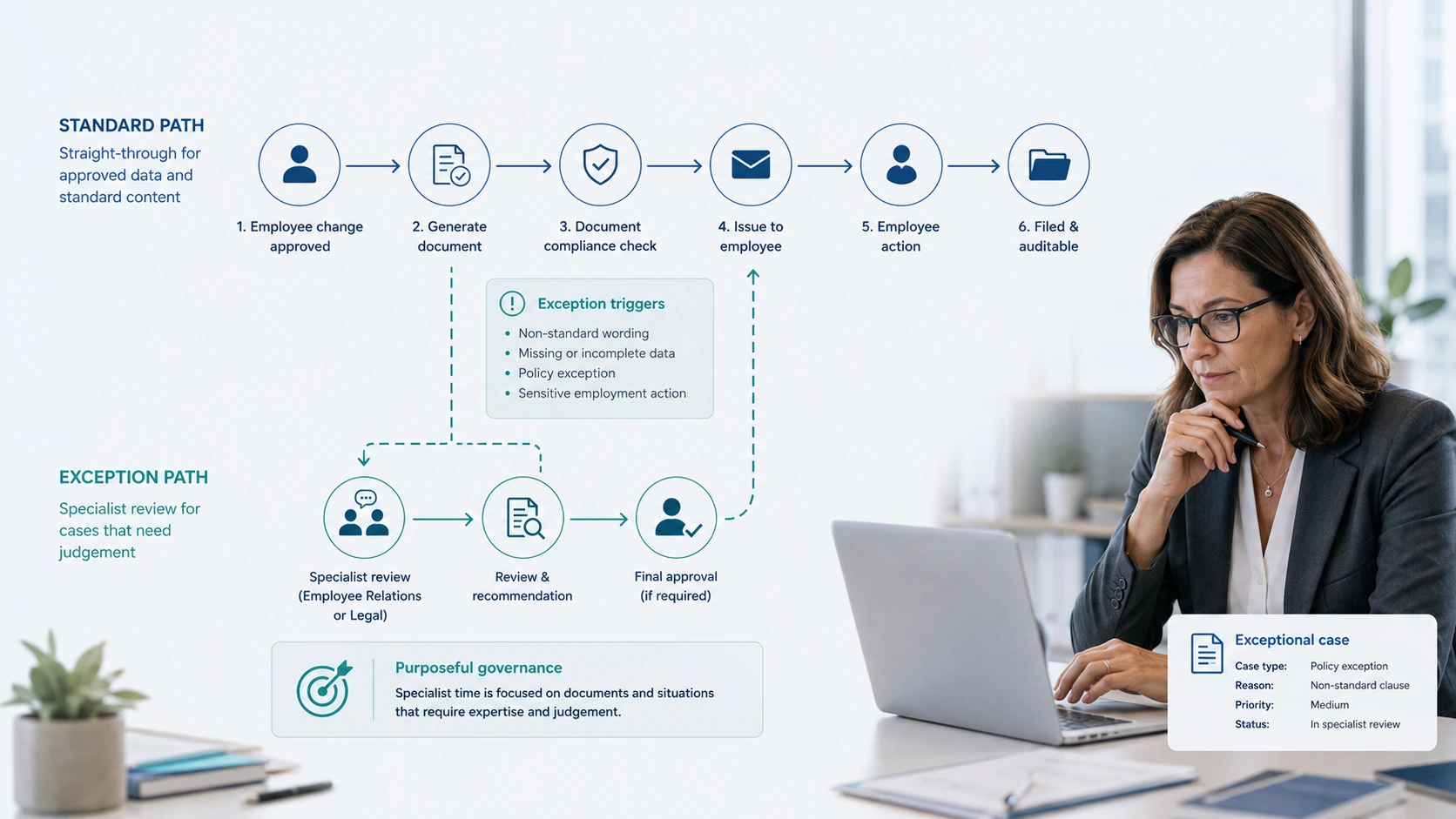
Not every document presents the same level of risk.
A standard document created from approved data and governed content is different from one containing negotiated terms, an unusual clause, or an exception to policy. Sending both through the same extended approval chain may add unnecessary effort without improving the quality of the standard case.
A more targeted approach is to trigger additional review when defined conditions apply. Employee Relations, Legal, or another specialist may need to become involved where:
non-standard wording has been selected
a clause has been manually amended
an exception to policy has been requested
the document relates to a sensitive employment action
required data is missing or inconsistent
a particular employee category or jurisdiction requires additional review
This allows standard cases to follow a more direct path while preserving specialist judgement where it provides genuine value.
The intention is not to weaken governance. It is to focus governance on the circumstances that require it.
Designing a Workflow in Which Every Step Has a Purpose
A well-designed document workflow should be easy to explain.
For every participant, the organisation should be able to identify what the person is reviewing, what authority they hold, what they can change, and what should happen if they reject or request an amendment.
It should also be clear whether the same decision has already occurred elsewhere, whether the person’s action genuinely needs to stop the process, and whether notification, reporting, or audit evidence could meet the requirement instead.
These questions help distinguish meaningful controls from inherited process habits. They also create a workflow that is easier to operate, monitor, explain, and maintain after implementation.
The aim is not to create the shortest possible workflow. Some documents carry significant legal, financial, employee-relations, or organisational risk and may legitimately require several review and approval points.
The aim is to create purposeful governance.
Approval should be used where a decision is required. Review should be used where judgement or validation is needed. Signature should reflect the organisation’s authority model, while notifications, reporting, and audit history should provide visibility without unnecessarily interrupting the process.
Final Thought
One of the most important questions in a document generation implementation is not
Who should be included in the workflow?
It is:
What does each person actually need to do?
A stakeholder may need to approve a decision, review a document, authorise its issue, sign it, receive a notification, or verify later that the process occurred.
Treating each of those needs as an approval can make the workflow slower without necessarily making it stronger.