
Why inbound documents need the same structure, control, and governance as documents produced by HR

Sheryl Grant
Global Enablement Lead
Not every document in an employee file is created by HR.
Employment contracts, offer letters, policy acknowledgements, and employee change letters usually follow defined processes. They are created from approved templates, use known employee data, and move through established review and approval steps.
But a significant proportion of HR documentation enters the organisation from somewhere else.
Medical certificates, identification documents, licences, compliance forms, third-party reports, employee-submitted files, and scanned records may all become part of the employee file. These documents still need to be classified, stored, protected, retrieved, and retained appropriately, but they do not begin within a controlled HR document process.
That is what makes them easier to overlook and, in many cases, harder to manage.
The Other Side of HR Document Management
HR document strategies often focus on the documents the organisation produces.
That is understandable. Generated documents are usually easier to standardise because HR controls the template, the employee data, the approval process, the delivery method, and the final storage location.
Inbound documents are different.
They may be created by an employee, healthcare provider, regulator, external organisation, manager, or another internal team. They may arrive as a PDF, image, email attachment, scanned document, or uploaded file.
The document may be valid and important, but it can arrive with little context and no consistent structure. This creates a different document management challenge.
There Is Often No Standard Entry Point

Inbound HR documents can enter the organisation through many channels.
An employee may email a medical certificate to their manager. An identification document may be uploaded during onboarding. A licence renewal may be sent to a shared mailbox. A paper form may be scanned by a local HR team, while a third-party report may be saved directly to a shared drive.
Each method may work well enough on its own, but the problem begins when there is no consistent process for what happens next.
Documents may be stored in different locations, handled differently by each team, forwarded between inboxes, or left unprocessed. In some cases, the file exists but is not connected to the employee record or visible to the people who need it.
The issue is not simply that documents arrive through different channels. It is that they may never enter a controlled process once they arrive.
Classification Becomes a Manual Task
A generated document usually has a known type before it is created. An inbound document may need to be interpreted first.
Someone may need to determine what the document is, which employee it relates to, which category applies, whether it contains an effective or expiry date, where it should be stored, and who should be able to access it.
In many organisations, these decisions rely on manual review.
This creates administrative work and can also introduce inconsistency. Similar documents may be categorised differently by different people. A file may be linked to the wrong employee, or important information may be overlooked, particularly when volumes are high or the document itself is difficult to interpret.
The more the process depends on individual judgement, the harder it becomes to apply a consistent standard.
Metadata Is Often Missing

System-generated documents usually carry useful context.
The document type is known. The employee is already identified. Relevant dates may be drawn from the HR system. Naming conventions can be applied automatically, and the relationship between the document and the underlying HR process is clear.
Inbound documents often arrive without this information.
A file name such as scan001.pdf or IMG_2847.jpg says very little about the employee, the document type, the relevant date, or the retention requirement.
Without structured metadata, a document may be stored successfully but still remain difficult to retrieve, govern, or use as part of a complete employee record.
Fragmented Storage Becomes More Likely
Because inbound documents are less predictable, they are more likely to sit outside the formal employee file.
They may remain in personal inboxes, shared mailboxes, local folders, team drives, scanning locations, workflow attachments, or separate compliance systems. Over time, copies may also accumulate across several locations.
One version may sit in an inbox, another in a shared drive, and another in the employee file. It then becomes difficult to know which copy is authoritative and whether access is being managed consistently.
This is where an intake problem becomes a broader document management problem. The document exists, but its location, status, or relationship to the employee record is unclear.
The Operational Impact Is Larger Than It Appears

Handling one inbound document may take only a few minutes, but even that small task can involve opening the file, identifying it, renaming it, checking the employee, selecting a category, recording a date, saving it, and following up if information is missing.
Across a large workforce and multiple document types, that effort increases quickly.
HR teams may spend significant time interpreting documents, confirming ownership, renaming and filing files, correcting classifications, chasing missing information, and checking whether employee files are complete.
The process often appears to be working because HR keeps it moving, but much of the effort required to hold it together remains hidden.
Visibility Starts to Break Down
When inbound documents are managed inconsistently, HR may struggle to answer basic operational questions.
Has the required document been received? Has it been linked to the correct employee? Is the employee file complete? Does the document contain an expiry date? Who has access to it? Has the appropriate retention rule been applied?
These questions become harder to answer when intake, classification, and storage are handled separately.
The result is a visibility gap. HR may know documents are being received, but not whether they are being managed consistently from that point onward.
Governance Becomes Harder to Apply
Inbound HR documents may contain some of the organisation’s most sensitive employee information.
Medical records, identity documents, background checks, certifications, and third-party reports can all require careful access control and retention treatment.
Without consistent classification and metadata, it becomes harder to apply the right access permissions, retention periods, expiry monitoring, archival rules, deletion processes, and legal or audit controls.
A retention policy can only be applied reliably when the organisation knows what the document is, who it relates to, and which rule should govern it.
For that reason, inbound document management should not be treated as a filing activity alone. It is part of the organisation’s broader information governance model.
Why Inbound Documents Are Often Overlooked
Most HR transformation initiatives focus on structured processes.
They may prioritise digitising employee transactions, automating document generation, introducing electronic signatures, centralising employee files, or improving workflow and approvals.
Inbound documents do not always fit neatly into those initiatives because they are less predictable, more variable, and harder to standardise. As a result, they are often treated as exceptions around the main process.
Inbound documents are not rare exceptions. They are a regular part of HR operations.
Moving from Ad Hoc Handling to Structured Intake
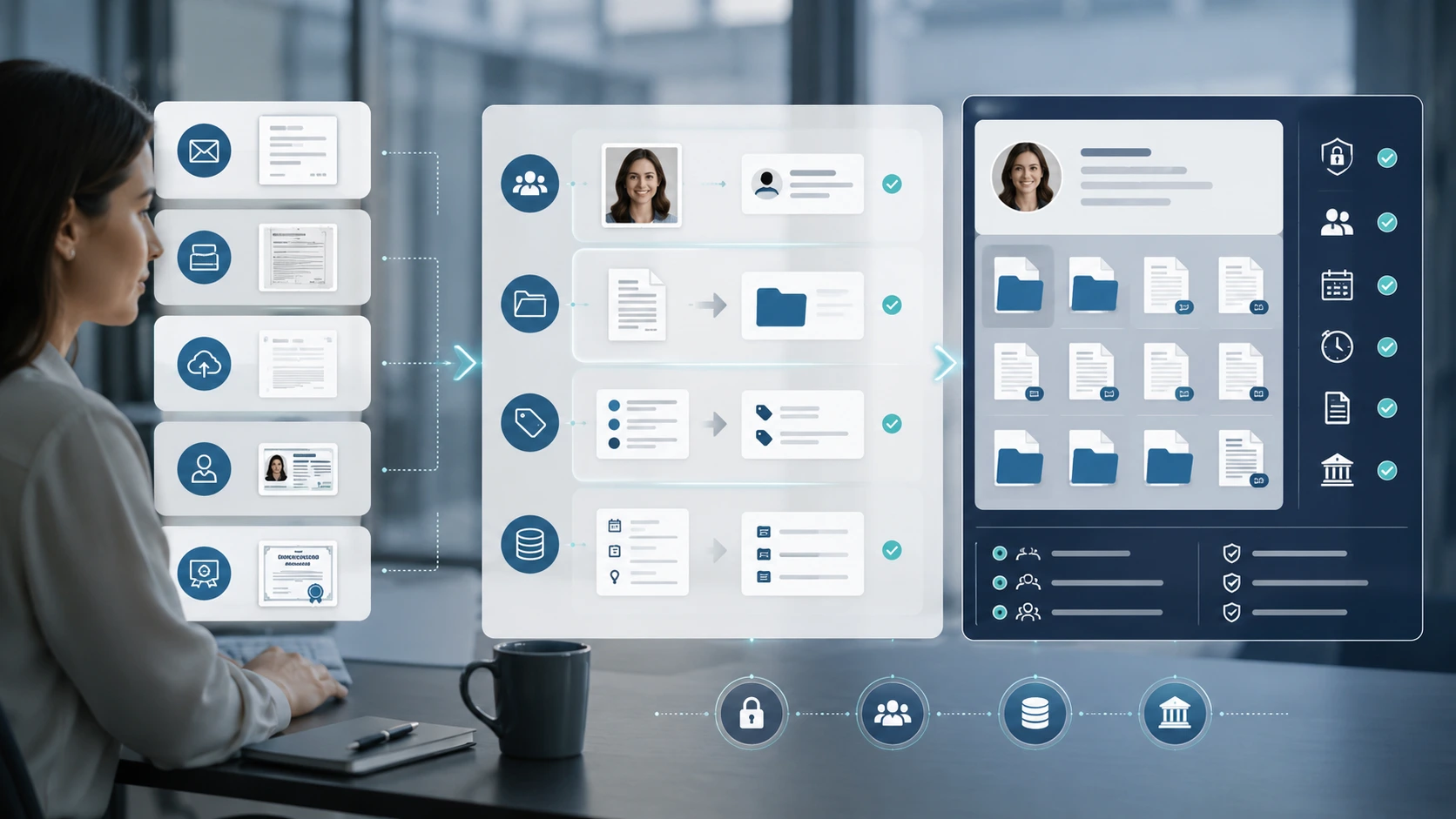
A more controlled approach begins by treating inbound documents as part of the HR document lifecycle, rather than as files that need to be managed separately after they arrive.
Clear intake rules still matter. Organisations need to define which documents can be received, how they should enter the process, and what information is required to manage them.
However, structure alone does not remove the operational burden if HR still needs to rename, classify, and file every document manually. This is where document management technology becomes important.
For organisations using SAP SuccessFactors, Strato Document Management for SAP SuccessFactors can support defined intake methods and bring inbound files into a structured digital employee file. Documents can be associated with the relevant employee, assigned a document type and metadata, and stored using consistent file-naming conventions.
This reduces the number of individual decisions HR needs to make about where a document belongs or what it should be called. Instead, the document enters an established structure connected to the employee record.
Once captured and automatically classified, inbound documents can be managed alongside generated and signed records. The same broader controls can then be applied, including role-based access, retention and archival rules, expiry information, audit history, legal hold, and controlled deletion.
The practical shift is from manually filing documents after they arrive to managing intake as part of a connected process.
HR may not control where a document originates, but it can create a more consistent way for that document to enter the employee file and be governed from that point forward.
From Exception to Standard Process
When intake, classification, storage, and governance are connected, organisations can reduce manual handling, improve visibility, and build a more complete view of the employee file.
The challenge is not only managing the documents HR creates. It is also bringing relevant inbound documents under appropriate control, regardless of where they originated.
The most important shift is recognising that inbound documents are a recurring part of the employee record and need to be included in the organisation’s document management model.
Final Thought
HR may not control where every document originates, but it does need a clear process for what happens once that document enters the organisation.
Effective HR document management is not only about the documents HR creates. It is also about the documents HR becomes responsible for.
Learn more about
Strato Document Management
See how Strato Document Management supports structured employee files, document intake, access control, retention, and governance for SAP SuccessFactors environments.