

Sheryl Grant
Global Enablement Lead
How modern HR document generation can capture employee decisions, preserve evidence, and update the right HR record
Employment offers and employment contracts have traditionally been treated as the final output of a process.
A role is approved. A candidate is selected. An employment change is confirmed. HR generates the correct document, sends it for review or signature, and stores the final signed record.
For many scenarios, that model still works. But in more complex HR environments, the employment document is starting to play a more active role.
In some cases, the document is not just presenting terms for acceptance. It also needs to capture a structured choice from the employee or candidate, reflect that choice in the final signed contract, and pass the decision back into the HR process so the correct downstream record is maintained.
That changes the purpose of the employment document. It is no longer just an output. It becomes part of the decision process.
The shift from static offer to structured selection
This type of requirement can appear in several parts of the employee lifecycle.
It may arise during an external recruitment process, where a candidate receives an offer and needs to select between available employment arrangement options. It may appear in an internal recruitment process, where an existing employee is moving into a new role. It may also occur during an employment change, where a new contract or variation is triggered for an existing employee.
In each case, the document may need to present more than one valid pathway.
For example, an employee or candidate may need to choose between terms aligned to an Enterprise Agreement and an Individual Flexibility Arrangement, where that is applicable and supported by the organisation’s employment framework.
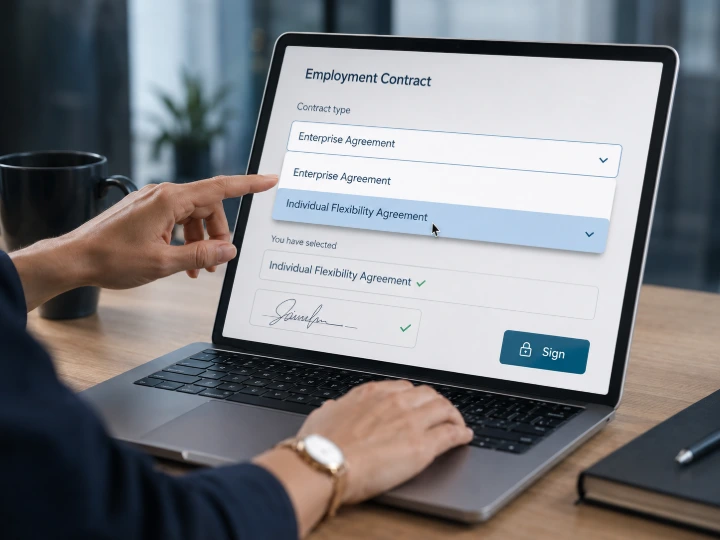
On the surface, this can look like a document template issue. In practice, it is a process design issue.
The organisation needs to know which option was selected, show that choice clearly in the final signed document, and retain evidence of the decision. The selection may also need to be written back to the candidate application, internal recruitment record, or employee record so the agreed arrangement can be reflected later in SAP SuccessFactors.
That is where the complexity starts to appear.
Why this matters for HR operations
When a document contains a choice, the process around the document becomes more important.
It is not enough to generate the correct wording. HR also needs to manage the point of selection.
That includes questions such as:
- Was the employee or candidate presented with the correct options?
- Was the selected option captured before signature?
- Does the signed contract clearly show what was chosen?
- Has the decision been retained as evidence?
- Has the selection been written back to the right record?
- Will the employee record reflect the agreed arrangement once the process is complete?
These questions matter because the decision may affect more than the document itself. It may influence downstream HR data, classification, employment conditions, payroll interpretation, reporting, or future document generation.
If that decision is handled manually, the risk is not just administrative effort. The risk is that the signed document, the recruitment application, and the employee record may no longer tell the same story.
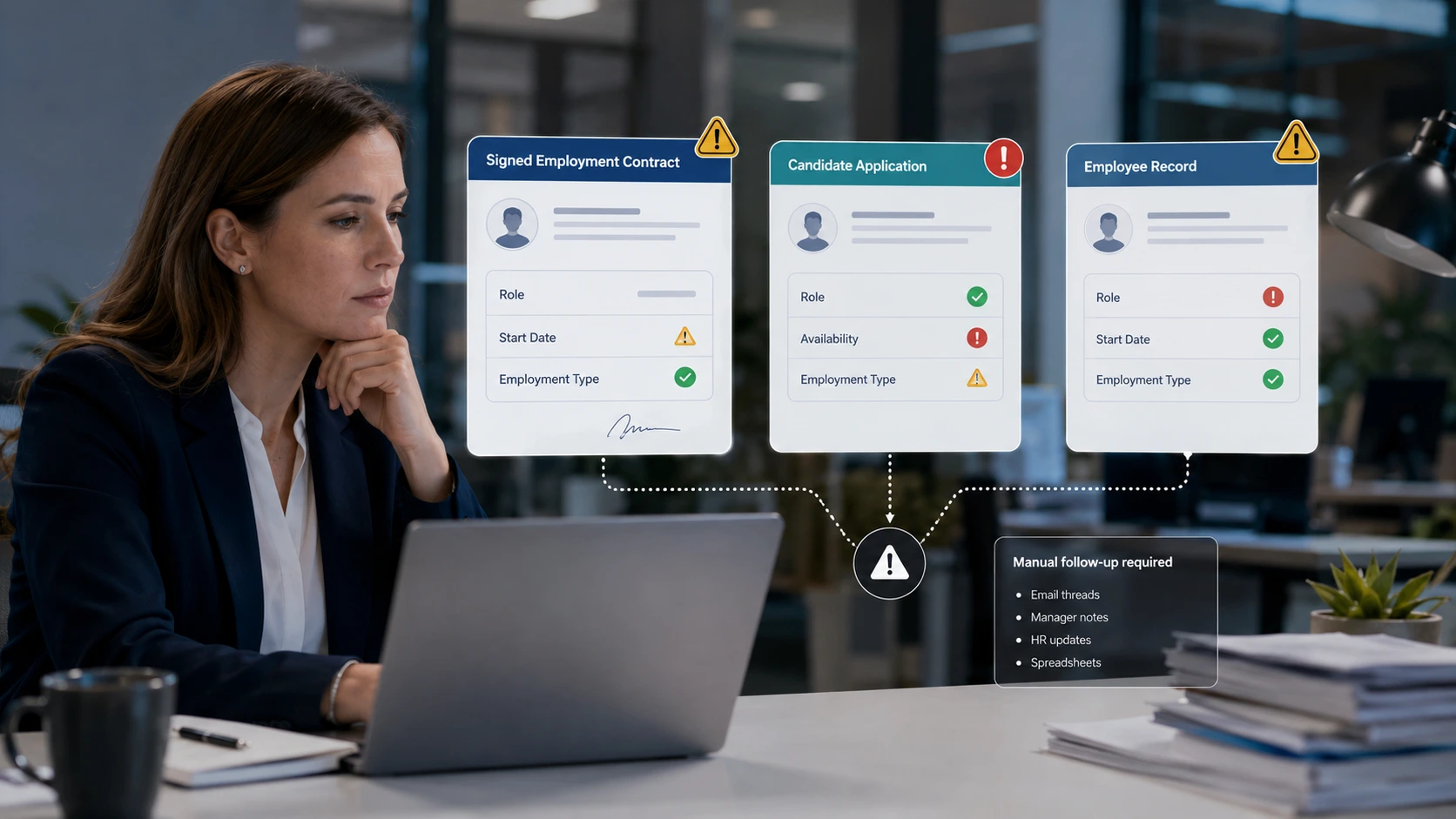
The challenge with manual workarounds
Many HR teams can manage this type of process manually for a small number of cases. They may capture the selection through email, add a note to the recruitment application, update a field manually, or rely on someone to interpret the signed contract and make the required downstream update.
That may work for low volume or isolated scenarios.
But as soon as the process is repeated across multiple roles, employee groups, business units, or employment change types, manual handling becomes harder to control.
The issue is not only whether the document was signed. The issue is whether the decision inside the document was captured accurately, transferred to the right record, and available for the next step in the employee lifecycle.
This is especially important where the person may not yet exist as an employee record. In an external recruitment process, the selection may need to sit against the candidate application first, then transfer later into the employment record once the hire is completed. In an internal process, the decision may need to update the existing employee record or support a future-dated employment change.
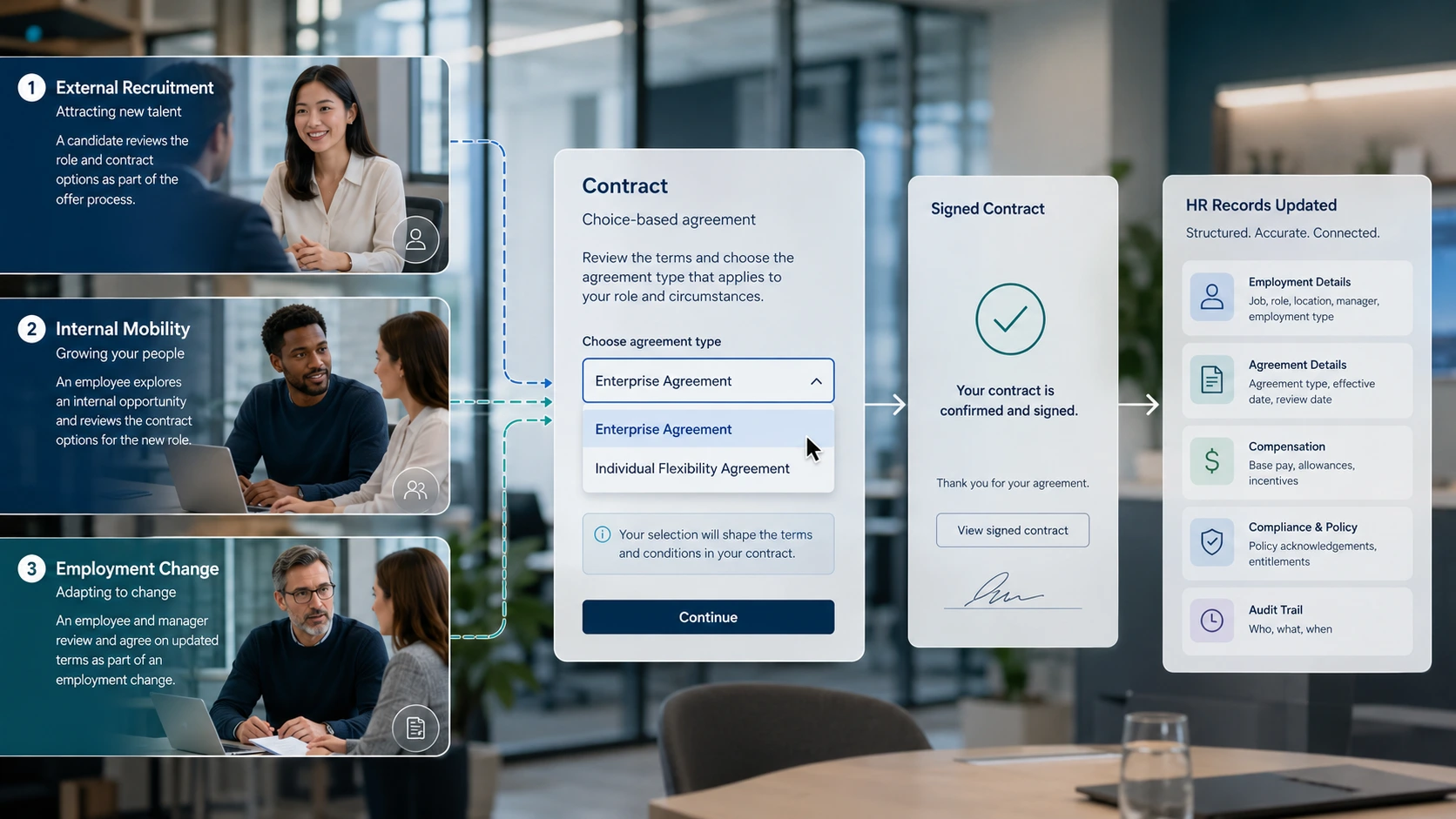
The document process therefore needs to work across the boundary between candidate, application, employment change, and employee record.
That boundary is often where manual processes become fragile.
A more mature document generation model
As HR document generation matures, the question is no longer only:
Can we generate the right contract?
The better question is:
Can the document process capture the decision that determines what happens next?
A more mature model allows the generated document to include the relevant options, capture the employee or candidate’s selection, reflect that selection in the final signed document, and pass the selected value back to the appropriate HR record.
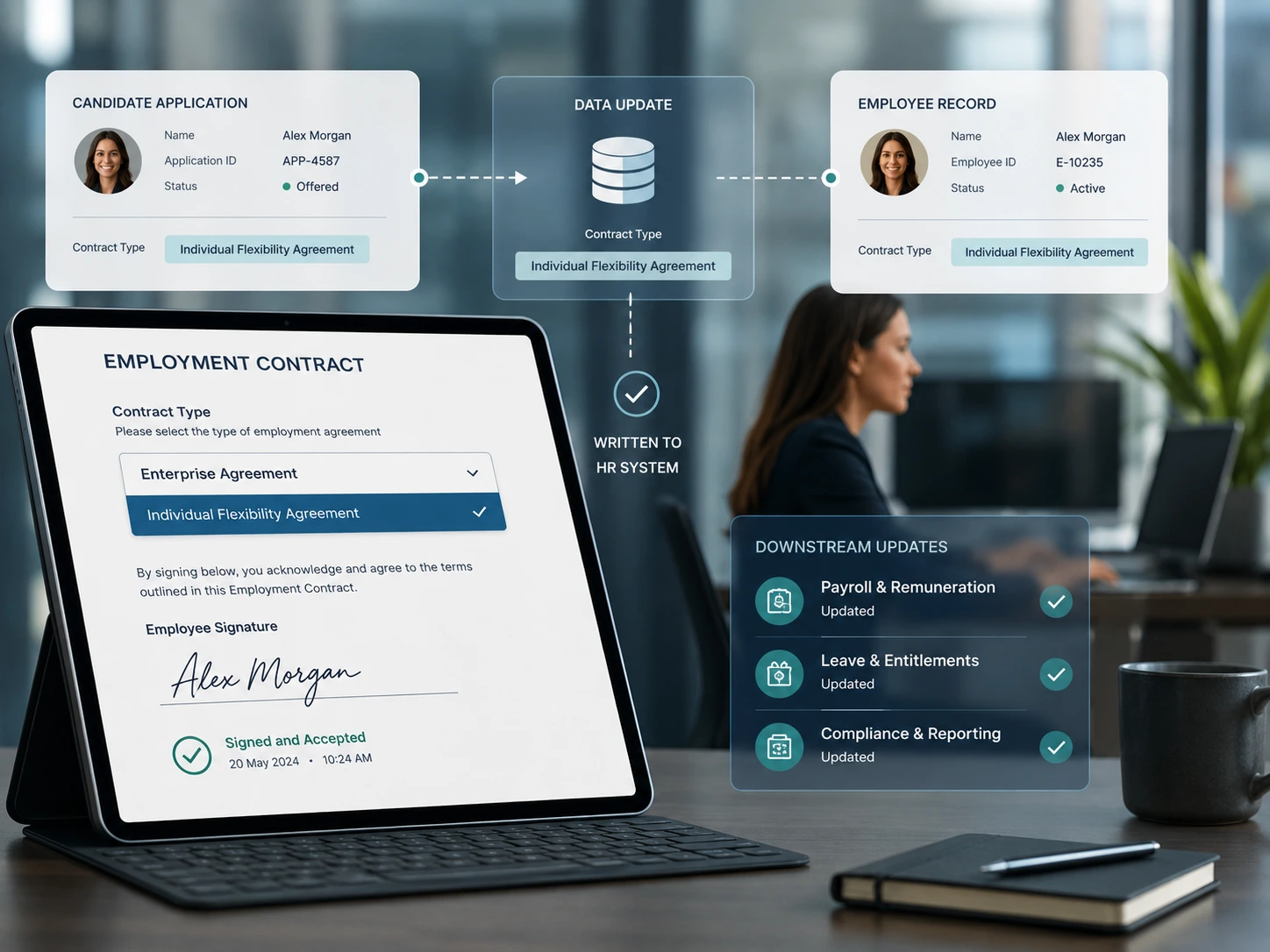
That creates a stronger link between document generation, signature, evidence, and system data.
It also helps HR move away from disconnected follow-up steps, such as manually checking what was selected, updating records after signature, or relying on email trails to explain why a particular arrangement was applied.
For organisations using SAP SuccessFactors, this is particularly important because the offer, application, employment change, and employee record may sit across different parts of the employee lifecycle. If the choice made in the document has downstream relevance, it should not remain trapped inside the signed PDF.
It should be captured as structured information that can support the next step in the process.
Why this is becoming a buying consideration
For some organisations, this type of requirement is becoming an important consideration when evaluating HR document generation applications.
That makes sense.
A simple document generation tool may be able to produce multiple templates. But this scenario requires more than template selection.
It requires the document process to support interaction, decision capture, signing, evidence retention, and write-back to the right system record.
In Strato Document Generation, this type of process can be designed so the generated contract presents structured options, captures the employee or candidate’s selection, reflects the choice in the signed document, and writes the selected value back to the relevant SAP SuccessFactors record. Depending on the scenario, that may be the candidate application, an internal recruitment record, or the employee record itself.
That is a different level of process maturity.
It reflects a broader shift in HR document operations. Documents are no longer just static records created at the end of a workflow. In certain scenarios, they are becoming controlled points where decisions are captured, confirmed, and carried forward into the employee lifecycle.

Final thought
Employment contracts and offers will always need to present terms clearly. But in more complex HR environments, they may also need to do something else.
They may need to capture a choice.
When that choice affects the employee record, the recruitment process, payroll interpretation, or future HR activity, it should not be managed through manual notes, email trails, or disconnected updates.
It should be built into the document process from the start, so the final record reflects not only what was sent, but what was agreed.
Because in these scenarios, the document is more than evidence of the offer.
It is also evidence of the decision.